The Bee Waggle Dance Explained: How Honeybees Give Directions
The bee waggle dance is how a honeybee tells her nestmates exactly where to find food. Back in the hive, she runs in a straight line while shaking her body, then loops around and repeats. The angle of that straight run shows the direction of the food compared to the sun. The length of the run shows how far away it is.
It’s one of the most remarkable communication systems in the animal world, and decoding it earned a Nobel Prize. Here’s how the dance works, step by step, and what scientists have learned since.
How the Bee Waggle Dance Works
The Basic Pattern
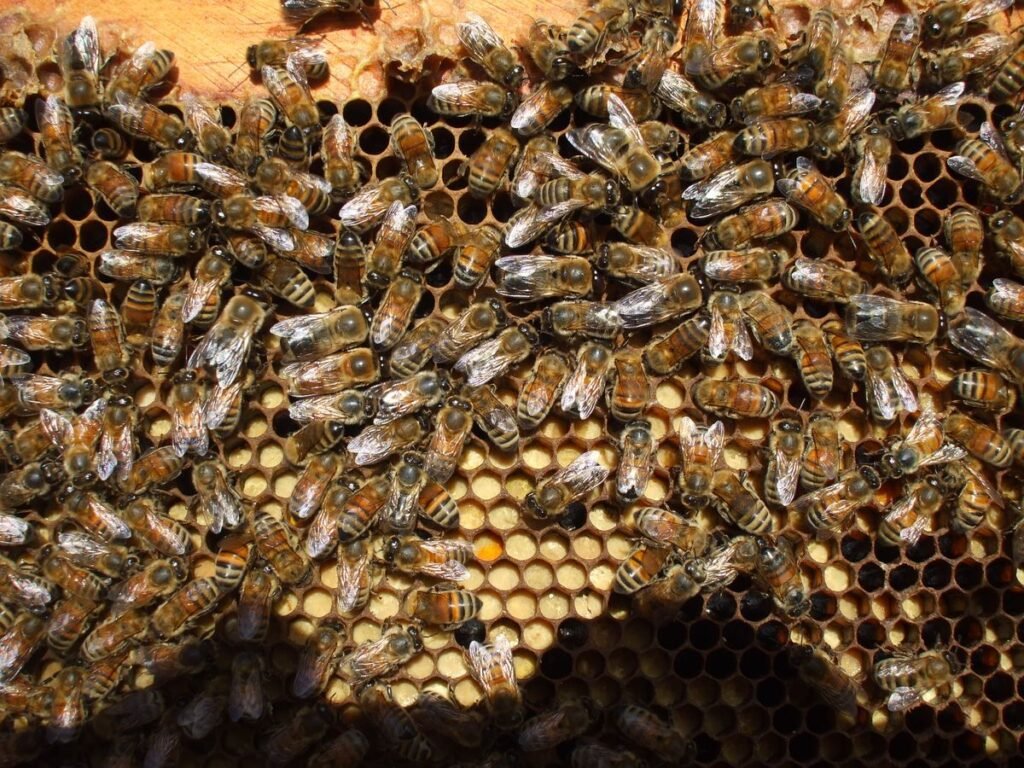
A forager bee that has found a good patch of flowers returns to the hive and dances on the vertical surface of the honeycomb. The dance has two parts:
- The waggle run: she walks forward in a straight line while waggling her abdomen from side to side and buzzing her wings.
- The return loop: she circles back to the start, alternating left and right loops, so the whole dance traces a figure-eight.
She repeats this many times. Other bees follow closely behind her, picking up the information through touch, vibration and smell in the darkness of the hive.
How Bees Show Direction
Inside the hive it’s dark, and the comb is vertical, so the bee can’t point at the sun. Instead, she uses gravity as a stand-in:
- A waggle run straight up the comb means “fly toward the sun.”
- A run straight down means “fly away from the sun.”
- A run 40 degrees to the right of vertical means “fly 40 degrees to the right of the sun.”
The bee translates a direction in the outside world into an angle on the comb, and her nestmates translate it back.
The sun moves across the sky during the day. Remarkably, dancing bees adjust their angle over time to account for this.
How Bees Show Distance
Distance is shown by how long the waggle run lasts. Longer waggle runs mean the food is farther away. In European honeybees, roughly one second of waggling corresponds to around a kilometer of flight, though the exact relationship varies between colonies and landscapes.
Bees seem to judge distance by how much scenery passes by their eyes during the flight, a bit like an odometer based on vision.
Round Dances for Food Nearby
When food is very close to the hive, bees perform a shorter, circling dance with little or no waggle run. It mainly says “there’s food nearby, go and look.” Scientists once saw this as a completely separate dance. Today, many see it as the short-distance end of the same system.
Karl von Frisch and the Nobel Prize
Austrian scientist Karl von Frisch spent decades studying how honeybees communicate. He trained bees to visit feeding stations at known distances and directions, then watched how they danced when they returned to glass-walled observation hives.
He showed that the dance carried real information about direction and distance. Many scientists found this hard to believe at first. An insect with a brain smaller than a grain of rice, using a symbolic code?
In 1973, von Frisch shared the Nobel Prize in Physiology or Medicine with Konrad Lorenz and Nikolaas Tinbergen for their work on animal behavior.
Later experiments confirmed his findings. Researchers built robotic bees that performed waggle dances inside real hives, and live bees flew in the directions the robot “told” them.
More Surprising Facts About the Waggle Dance
Bees Rate How Good the Food Is
Not every forager dances, and not every dance is the same. Bees that find rich nectar close to the hive dance longer and more enthusiastically, repeating more circuits. That draws more recruits. As a food source runs low, returning bees dance less or stop, so fewer bees are sent there.
No single bee is in charge, yet the colony as a whole sends most of its foragers to the best food. Scientists study this as a classic example of collective decision-making.
Young Bees Get Better With Practice
A 2023 study found that young bees learn to dance more accurately by following experienced dancers before they start foraging. Bees that grew up without older dancers to watch made more mistakes, especially in their distance signals. Part of the dance is instinct, and part is learned.
Bees Use Dances to Choose a New Home
When a colony swarms to find a new home, scout bees inspect possible nest sites and dance to promote the ones they like. Scouts backing different sites can deliver short “stop signals,” head-butting rival dancers to dampen their dances. Over time, one site wins enough support and the swarm flies there. It’s a remarkable group decision made without a leader.
Different Honeybee Species Have “Dialects”
Different honeybee species link waggle duration to distance in slightly different ways. Asian honeybees (Apis cerana) and European honeybees (Apis mellifera) use different scales. In one experiment, researchers put the two species together in mixed colonies. The Asian bees gradually learned to follow the European bees’ dances, showing that bees can adjust to a different “dialect.”
Only Honeybees Do It
The waggle dance is found in honeybees, the genus Apis. Bumblebees and most other bees don’t dance this way. They use other signals, like excited running and scents, to tell nestmates that food is available.
Why the Waggle Dance Matters Today
Scientists now decode waggle dances from video to map where bees are finding food. This shows which plants and landscapes matter most to colonies, and helps guide conservation and farming decisions.
Bee communication also inspires engineers who design swarm robots and algorithms that solve problems through simple local rules, much like a hive does. If you enjoy surprising animal behavior, see why sharks bite surfers, or imagine what it would be like if humans developed a new sense, like a bee’s ability to see ultraviolet light.
Frequently Asked Questions
Why do bees dance instead of using sounds or smells?
They use all three. The dance comes with buzzing vibrations, and dancers carry the scent of the flowers they visited. The movement is what carries the direction and distance information, while scent helps recruits recognize the right flowers when they arrive.
How far away can a waggle dance send bees?
Honeybees commonly forage within a few kilometers of the hive and sometimes much farther. The dance can signal food at these distances, although bees prefer good sources closer to home.
Do bees dance in the dark?
Yes. Most dances happen inside the dark hive. Nestmates follow by touch, by sensing vibrations through the comb, and by detecting air currents from the dancer’s wings.
Can scientists read bee dances?
Yes. By measuring the angle and length of waggle runs on video, researchers can work out where bees have been foraging. Computer programs can now decode dances automatically.
The Bottom Line
The bee waggle dance turns a flight across the landscape into a short routine on the honeycomb. The angle shows direction, the length shows distance, and the energy of the dance shows quality. It’s a real communication system, refined over millions of years. For another surprising look at how brains handle information, read about forgetting what you were thinking.