12 Strange Facts About Dolphin Sleep Nobody Talks About

Dolphins can stay awake and alert for up to 15 consecutive days without showing any signs of cognitive decline — a feat that would leave a human completely non-functional after just three or four days without sleep.
Dolphin sleep is one of the most mind-bending biological phenomena in the entire animal kingdom, and the fact that you’re reading about it at 3am somehow feels extremely appropriate. While you’re lying in bed struggling to shut your brain off, dolphins are out in the ocean doing the literal opposite — deliberately keeping half their brain switched on while the other half takes a nap.
It sounds like science fiction. It sounds like something a sleep-deprived person would make up. But it’s completely, verifiably real, and once you understand why it works this way, you’ll never look at a dolphin the same way again.
This isn’t just a quirky animal trivia fact. It’s a window into how life adapts to impossible problems — like needing to breathe air while living underwater, or staying alive in an ocean full of things that want to eat you. Dolphins solved both of those problems in one extremely elegant, extremely weird way.
Let’s get into it.
🎯 Key Takeaways
- Dolphins use unihemispheric slow-wave sleep — only one brain hemisphere sleeps at a time, while the other stays conscious.
- The eye connected to the sleeping brain hemisphere closes, while the other stays open — that’s where the “one eye open” thing comes from.
- This adaptation allows dolphins to surface for air, watch for predators, and maintain social bonds even while resting.
- Dolphins can effectively suppress the need for REM sleep for weeks, something no human can do without severe consequences.
- Several other marine mammals — including whales, seals, and manatees — have evolved similar or related sleep strategies to survive ocean life.
What Is Dolphin Sleep, Exactly?
The Science of Sleeping With Half a Brain
Dolphin sleep operates on a system called unihemispheric slow-wave sleep (USWS) — a process where one cerebral hemisphere enters a sleep state characterized by slow brain waves, while the other hemisphere remains fully awake and functional. Think of it as your brain having a split-screen mode where one side is watching Netflix and the other is genuinely unconscious.
In humans and most land mammals, sleep is a whole-brain event. Both hemispheres go down together, you lose consciousness, your body enters a vulnerable state, and you trust your environment enough to check out completely. Dolphins cannot afford that luxury. The ocean doesn’t pause. Sharks don’t wait. And crucially, dolphins are not fish — they’re air-breathing mammals who will drown if they lose consciousness completely underwater.
So over millions of years of evolution, the dolphin brain developed a remarkable workaround. When it’s time to rest, one hemisphere shuts down into slow-wave sleep while the other remains alert, controls basic motor function, monitors the environment, and — most importantly — keeps track of when the dolphin needs to surface and breathe.
The sleeping hemisphere typically gets between one and two hours of rest before the brain essentially flips the switch. The rested side wakes up, the other side goes to sleep, and the dolphin continues its day having technically gotten a full rest cycle without ever losing consciousness. It’s biologically elegant in a way that makes human sleep look embarrassingly inefficient.
Why One Eye Stays Open
Here’s where it gets beautifully weird. The two cerebral hemispheres of a dolphin’s brain each control the opposite eye — just like in humans, where the left hemisphere processes input from the right visual field and vice versa. So when the left hemisphere is sleeping, the left eye closes. When the right hemisphere is sleeping, the right eye closes.
This means that at any given moment during dolphin sleep, you will see exactly one open eye and one closed eye. The open eye isn’t decorative. It’s connected to the active, watchful hemisphere — scanning for predators, monitoring social group behavior, and checking the position of the surface above.
Researchers observing dolphins in both wild and captive settings have confirmed this pattern repeatedly. Dolphins in a pod will often position themselves so their open eyes face outward from the group — essentially creating a living perimeter security system while everyone gets some rest. It’s coordinated, it’s strategic, and it’s genuinely impressive for a brain that also enjoys playing with seaweed for fun.
Unihemispheric Slow-Wave Sleep: The Biology Behind the Magic
Unihemispheric slow-wave sleep is not unique to dolphins — but dolphins are among the most studied and dramatic examples of it in the natural world. Birds, particularly migratory species, also use this system, which is part of why a bird can sleep on a wire without falling off and why certain species can sleep mid-flight during long oceanic crossings. Scientists studying unihemispheric slow-wave sleep in animals have found that the capacity seems to emerge in species that face one particular evolutionary pressure: the constant, non-negotiable threat of predation or environmental hazard during rest.
For dolphins, that pressure is doubled. Not only do they need to breathe every few minutes, but they live in an ecosystem where large sharks — particularly tiger sharks and great whites — are always a potential threat. Being completely unconscious in that environment is essentially signing your own death warrant. Evolution, unsurprisingly, disagreed with that outcome.
The dolphin brain activity during USWS is measurably different from normal waking consciousness. EEG studies — the kind that measure electrical activity across the brain — show distinct slow-wave patterns in the sleeping hemisphere that closely mirror the slow-wave sleep humans experience during the deeper stages of our own sleep cycles. The active hemisphere, meanwhile, shows normal waking-state brain waves. Two completely different neurological states, running simultaneously, in the same skull.
Interestingly, researchers at Nature have published studies showing that dolphins performing extended vigilance tasks — staying awake and alert for days at a time — show no significant performance degradation, suggesting their brains are optimized to recover efficiently during these brief alternating rest cycles in ways that human brains simply cannot replicate.
What’s particularly fascinating about unihemispheric slow-wave sleep is what it tells us about the nature of consciousness itself. Sleep isn’t just about the body resting — it’s about the brain processing, consolidating, and recovering. The fact that half a brain can handle all of that while the other half stays on guard challenges some of our most basic assumptions about what sleep is and what it’s actually for.
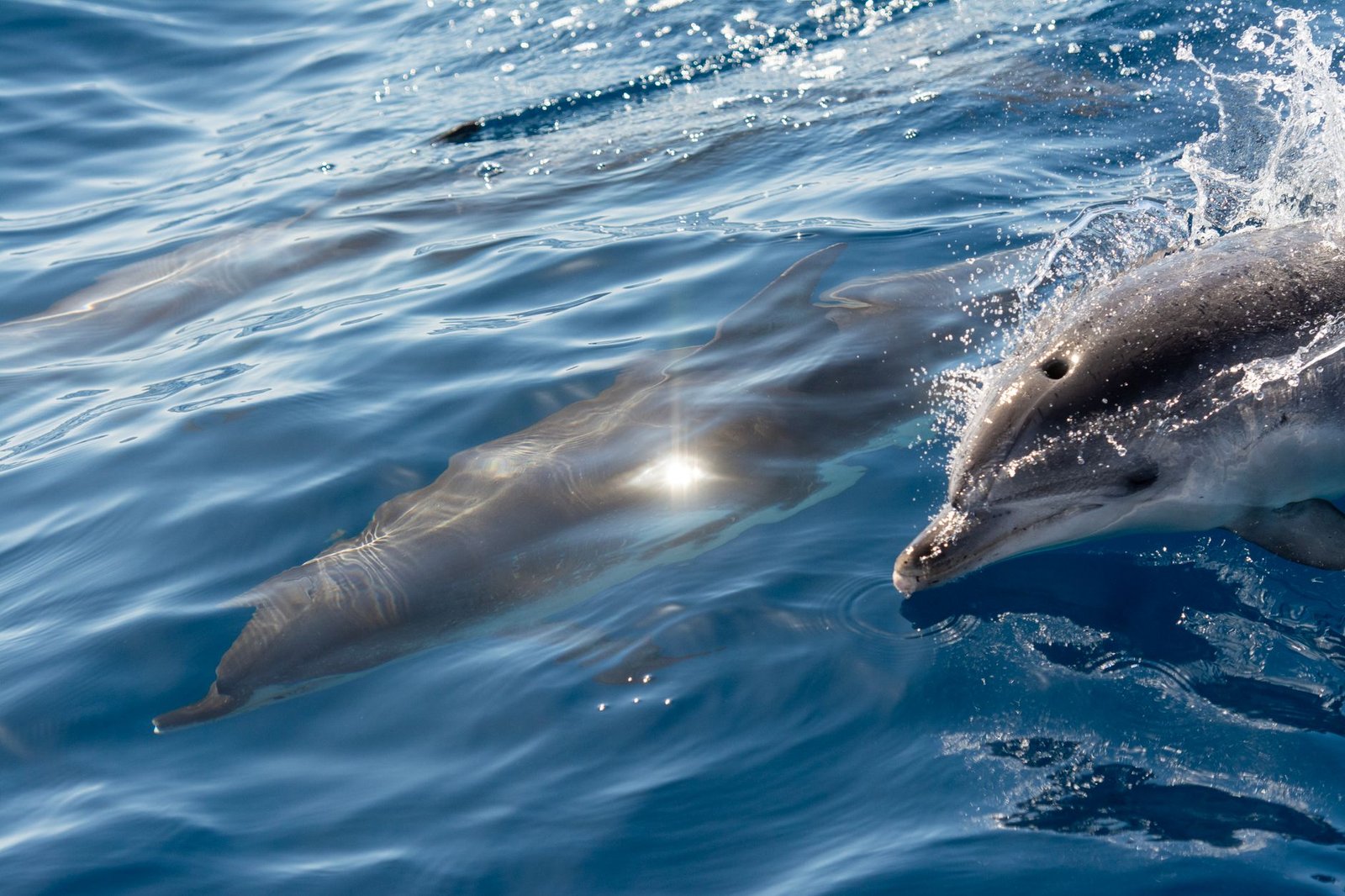
Bottlenose dolphins in captivity have been observed swimming in slow, tight circles for hours during rest periods — a behavior called “logging” — and EEG readings during this time confirm that half their brain is genuinely asleep while the other navigates. They’re literally sleepwalking in slow circles. In the ocean. Every single night.
Marine Mammal Sleep Patterns Across the Ocean
It’s Not Just Dolphins Doing This
When you start looking at marine mammal sleep patterns, a fascinating picture emerges: the ocean is full of animals that have had to solve the same impossible problem, and they’ve each come up with slightly different solutions. The need to breathe air while living in water creates one of evolution’s most persistent engineering challenges, and sleep is right at the center of it.
Sperm whales, for instance, have been observed floating vertically near the surface in what researchers call “drift diving” — a behavior that was only confirmed as actual sleep in 2008 when a research team accidentally sailed into a pod of completely motionless, sleeping sperm whales. The whales were so deeply asleep they barely reacted to the boat’s presence. Sperm whales appear to sleep in short bursts of around 7 to 24 minutes at a time, and they may only sleep for about 7% of their total day — potentially the least sleep of any animal on Earth.
Fur seals take an even wilder approach. In water, they use unihemispheric sleep like dolphins. On land, they switch to full bihemispheric sleep — both sides of the brain going down simultaneously — because on land, they’re relatively safe and don’t need to stay partially conscious. Their brains essentially shift modes depending on the environment. The flexibility alone is staggering.
Manatees, those slow and wonderfully round marine mammals, solve the breathing problem differently: they just float to the surface every few minutes without fully waking up, the same way you might roll over in your sleep without waking up. Their autonomic nervous system handles the surfacing reflex so efficiently that it doesn’t require consciousness.
What About REM Sleep in Dolphins?
This is where things get genuinely complicated. Dolphin brain activity research suggests that dolphins do experience some REM sleep — the stage associated with dreaming in humans — but only in very brief episodes, and potentially only when both hemispheres are briefly resting simultaneously during shallow-water periods. Some researchers believe dolphins may enter a kind of micro-REM state that lasts only seconds, giving the brain just enough of that deep-cycle processing to function without the extended vulnerability of full REM sleep. It’s like cramming a full night’s worth of dreaming into a 30-second power nap.
What This Tells Us About the Brain, Consciousness, and Sleep Itself
Here’s the part that should genuinely mess with your head. When we study dolphin sleep, we’re not just learning about dolphins. We’re getting a glimpse into what the brain actually needs from sleep — stripped of all the environmental assumptions we’ve made because we evolved on land, surrounded by shelter, with the luxury of total unconsciousness.
Cetacean consciousness research has become a serious field in neuroscience, partly because of how dolphins sleep. If a brain can divide itself into sleeping and waking halves — processing slow-wave recovery in one hemisphere while maintaining full predator awareness in the other — it raises profound questions about how unified human consciousness actually is. Our brains have two hemispheres too. We just don’t use them the way dolphins do.
Studies on sleep deprivation in dolphins have also produced counterintuitive results. When scientists prevented dolphins from sleeping normally over extended periods, they showed a remarkable ability to compensate — their active hemisphere seemed to take on more restorative function than usual, essentially stretching its efficiency to cover the deficit. Humans, by contrast, start hallucinating after about 72 hours without sleep and experience organ failure shortly after. Our tolerance for sleep deprivation is embarrassingly fragile by comparison.
The concept of aquatic respiration — or more accurately, the lack of it — is central to all of this. Everything strange about how dolphins sleep traces back to one fundamental fact: they breathe air. That single evolutionary constraint, the requirement to surface, shaped the entire architecture of how their brains rest. It’s a reminder that biology doesn’t design from scratch — it adapts, patches, and repurposes, and sometimes the results are so bizarre and brilliant that they seem impossible until you understand the problem they were solving.
There’s also something to be said for what dolphin sleep reveals about brain hemisphere independence. The two sides of a dolphin’s brain can operate in completely different neurological states simultaneously without any apparent conflict or dysfunction. This has led some neuroscientists to speculate about whether humans might theoretically develop partial forms of USWS under extreme conditions — though so far, the evidence for human unihemispheric sleep remains thin and largely anecdotal.
Frequently Asked Questions
Why do dolphins sleep with one eye open?
Dolphins sleep with one eye open because each eye is controlled by the opposite brain hemisphere. During dolphin sleep, only one hemisphere rests at a time — the other stays awake to monitor for predators, control breathing, and maintain social awareness. The eye connected to the sleeping hemisphere closes, while the eye connected to the active hemisphere stays open and watchful. It’s less about the eye and more about which half of the brain is currently off duty.
Do dolphins ever sleep with both eyes closed?
Rarely, and only briefly. There is limited evidence that dolphins may occasionally enter a state where both hemispheres rest simultaneously, but these episodes are extremely short — potentially just seconds — and typically only occur in safe, shallow environments. The vast majority of dolphin sleep happens with one eye open and one hemisphere active. Full bilateral sleep would leave them unable to breathe or escape threats, making it an enormous biological risk.
How long do dolphins sleep each day?
Dolphins typically sleep for about 8 hours per day, but not in one continuous block. They rest in shorter alternating cycles throughout the day and night, with each hemisphere getting roughly equal rest time over a 24-hour period. The rest sessions themselves can last anywhere from a few minutes to a couple of hours. Some dolphins in the wild appear to do more resting during certain parts of the day depending on feeding and social activity patterns.
Can dolphins drown while sleeping?
Theoretically, a dolphin that somehow lost all consciousness could drown, but in practice, dolphin sleep is specifically designed to prevent this. The active hemisphere during unihemispheric sleep retains control of voluntary breathing and motor function, ensuring the dolphin surfaces to breathe every few minutes even while resting. There are rare documented cases of very young dolphins or severely ill dolphins drowning, but in healthy adults, the sleep system is robust enough to make this essentially impossible under normal circumstances.
Do other animals sleep with one eye open like dolphins?
Yes — unihemispheric slow-wave sleep has been documented in several species beyond dolphins. Many birds use this system, especially during migration or when roosting in exposed locations. Certain species of sharks and fish show related patterns of rest, and other marine mammals like fur seals and possibly some whale species use similar strategies. The trait appears to evolve independently in different lineages whenever animals face the dual pressure of needing rest while remaining exposed to serious environmental threats.
✅ The Bottom Line
Dolphin sleep is a masterclass in evolutionary problem-solving. Because dolphins need to breathe air, avoid predators, and maintain social cohesion around the clock, their brains evolved the ability to rest one hemisphere at a time — keeping one eye open, one brain hemisphere alert, and one fin on the wheel at all times. It’s not just a cool animal fact — it’s a profound insight into how flexible the brain can be when survival demands it. The next time you’re lying awake at 3am wishing you could half-sleep, just know that somewhere in the ocean, a dolphin is doing exactly that, and honestly, pulling it off far more gracefully than either of us ever will.
Final Thoughts
Dolphin sleep is one of those facts that sounds simple — “they sleep with one eye open” — until you start pulling on the thread and realize it goes all the way down into the foundations of neuroscience, evolutionary biology, and the nature of consciousness itself. These animals have essentially hacked the concept of sleep, running two neurological states in parallel in a way that makes our rigid all-or-nothing approach look like a design flaw. And maybe it is. The more we study how non-human animals sleep, the more we realize how many assumptions we’ve built into our understanding of rest, consciousness, and what the brain actually needs to survive. So here’s a question worth losing more sleep over: if dolphins can split their brain’s rest in half without consequence — what else are we wrong about when it comes to how the mind works?